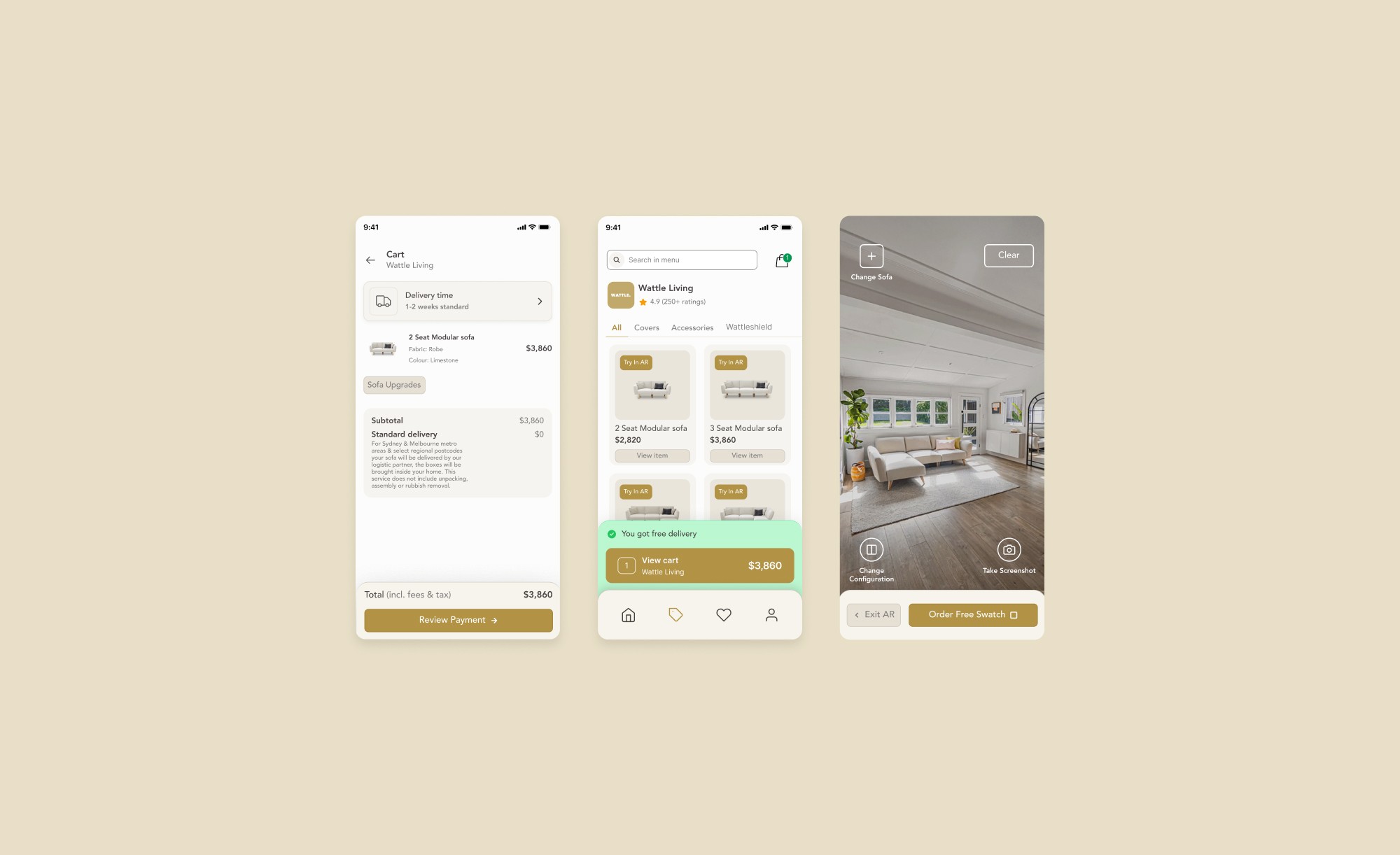
Enhancing trust in high-ticket e-commerce with AR experiences
Role
Product Designer
Responsibilities
Research Wireframing Usability Testing UX/UI Design
Timeline
Aug.2025 - Sep.2025
Project Overview
Problem
There is a lack of trust and confidence when purchasing high-ticket furniture items online, resulting in hesitation, delayed purchases, and lost revenue opportunities for Wattle Living.
Several customer support tickets flagged the same hesitation: customers weren't sure the sofa would actually fit or suit their space. I pulled a sample of those tickets and interviewed 5 customers to understand where that uncertainty was coming from, and whether it was a sizing issue, a style issue, or something else entirely.
Opportunity
Photos weren't solving the actual problem. Customers could see what the sofa looked like, but they couldn't tell if it would fit their space or suit it, whether the colour and material would actually work in their room. I pushed for AR because it let people measure their space against real dimensions and preview the sofa's materials in context, not just picture it in a generic listing photo. That was the gap static images couldn't close.
Solution
A mobile app that lets renters visualise Wattle's modular sofas in their own space to build trust and drive confident purchases
I aimed to help renters and frequent movers gain confidence in purchasing Wattle Living’s modular sofa online by enabling them to visualise it in their own space and explore its flexibility before making a high-ticket purchase. This solution not only builds trust with customers but also drives higher conversion rates and revenue for the business. This solution builds trust at the point where customers were hesitating most, not at checkout, but earlier, while they were still deciding if the sofa would work in their space. Letting people preview the sofa in their own room, in their own configuration, moved reassurance into the browsing stage instead of leaving it as an afterthought.
Goals for the project
Confident purchasing
Ensure the platform enables customers to visualise the modular sofa in their own space, explore different configurations, and feel secure making a high-ticket purchase online without needing a physical showroom.
Scalable digital experience
Create a digital alternative to an in-store showroom that builds trust and demonstrates product value at scale. This allows Wattle Living to improve conversion rates and revenue without the overhead of physical retail locations.
User Research
It started with nothing but a real problem...
The Wattle Living team came together to present us with a real problem they were facing:

And I got to understanding the problem space...
I affinity diagramed customer support tickets, conducted surveys, interviews, and meetings with subject matter experts to understand the problem and the key pain points and opportunities.
Surveys
Affinity diagram customer support tickets
Key insights from research
I assumed hesitation was mostly about product quality, something better photos or specs could fix. Research showed the real doubt was whether the sofa would fit their specific space and style, so I shifted focus toward visualisation tools instead of more product information.
Wireframes
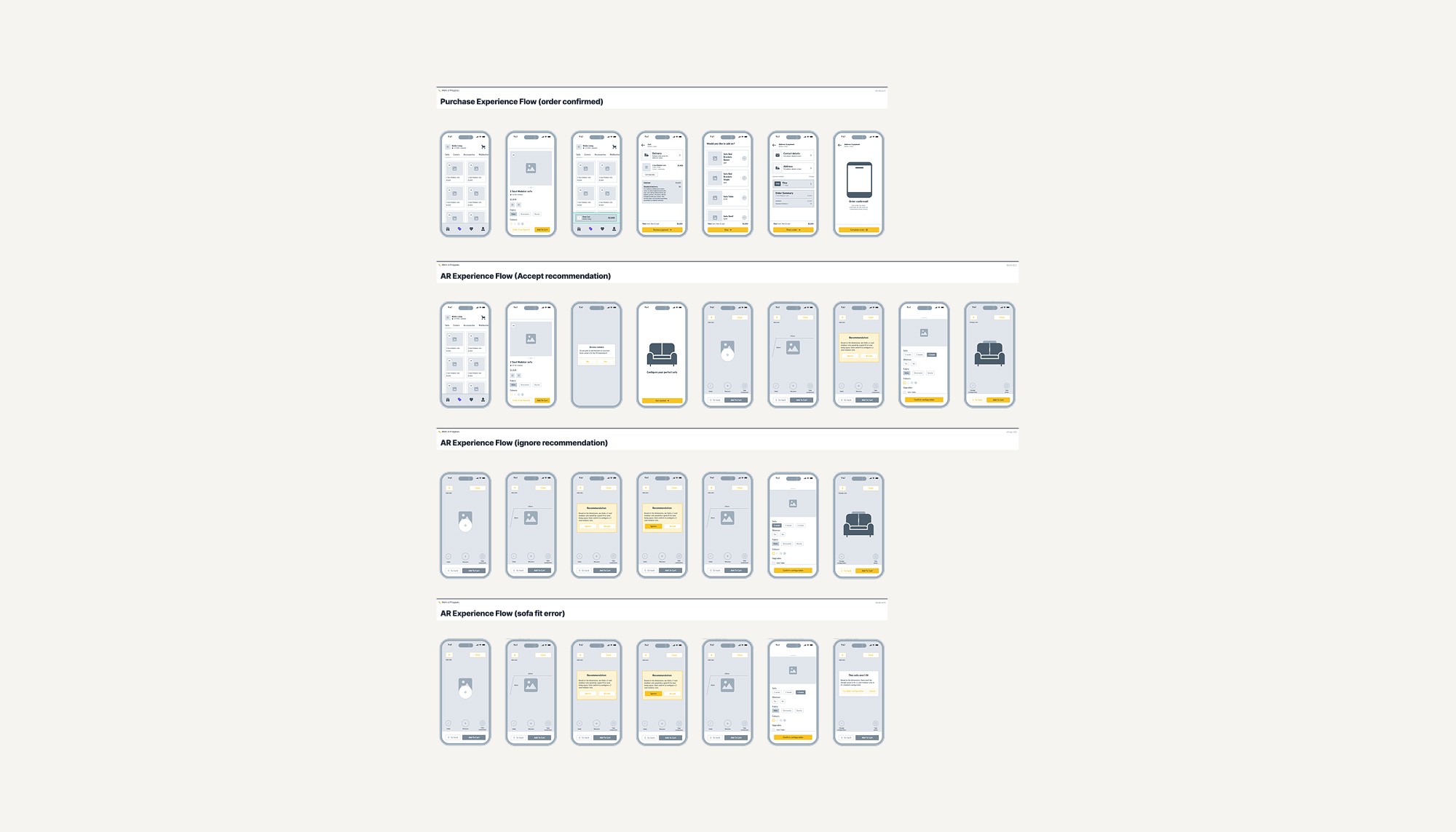
Beyond the core purchase flow, I mapped out separate paths for how the AR experience should behave when someone follows the fit recommendation versus when they override it, since customers wouldn't always agree with what the app suggested. That edge case became a key focus in later testing.
User Testing
Goals For Usability Testing
Early Concepts & Wireframes
First click testing
To measure the quality of the first click users make with specific tasks given to complete
Success Metrics
• Task Success Rate • Number of confusions/errors • Information Architecture Quality
Content & Copy Testing
Comprehension testing
Ensure that users understand the error flows in the AR experience
Success Metrics
• Comprehension Test Score (Y/N)
Participant Criteria(s):
5 Participants
1. Cohort: Ordered a free swatch from Wattle within the last month 2. Segment: Has a family and is currently or has moved houses
Usability tests we ran
Test #1
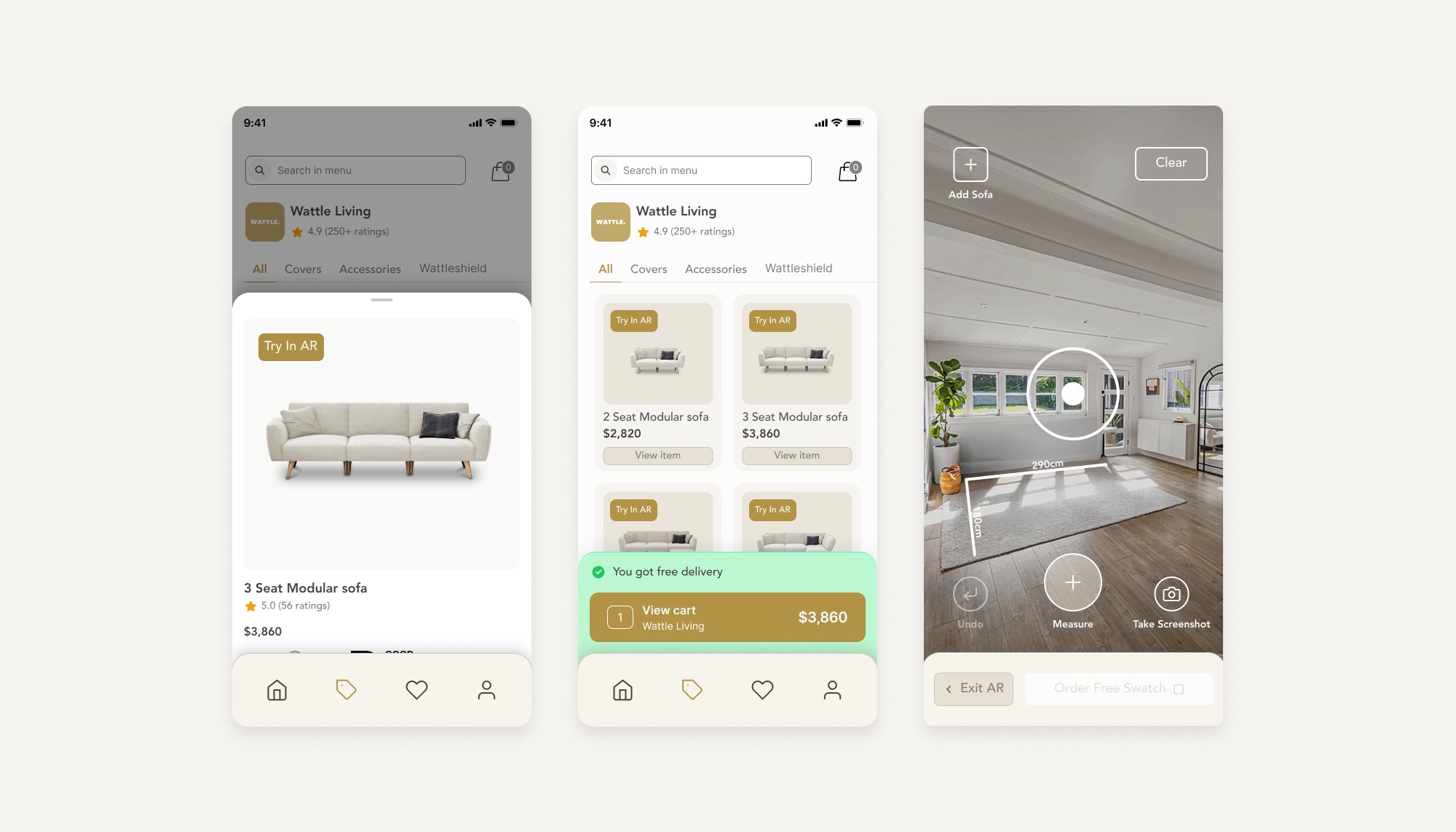
• Open the all product screen design • Ask what would you click to view a product • Ask what would you click to try the AR experience • Ask what would you click to measure the dimensions of the living space • Accept the recommendation
Learning Goals
To test whether participants can successfully: 1. Navigate to the AR experience screen easily without assistance 2. Use the measure feature to get the dimensions of the living space 3. Understand how to integrate the AR sofa into the space
Test #2
• Ask what would you click to measure the dimensions of the living space • Ask whether the dimensions are the same as the previous test • Ask the user to ignore the recommendation • Ask the user to add a sofa bigger than the recommendation
Learning Goals
To test whether participants can successfully: Explain what happens when you try to place an AR sofa thats larger than the dimensions measured into the space
Final Designs
Two decisions came out of this round of testing:
How we measured success
9 out of 10 participants
Task completion rate
32s
Avg. time to task completion
Reading the numbers
These numbers show people can complete the AR flow. What I'd still want to measure post-launch: cart abandonment rate and swatch-to-purchase conversion, to confirm the trust-building actually converts to revenue, not just task completion.

Finding
Missed AR button on smaller viewports
On smaller viewports, the AR button sat below the fold. Most users didn't scroll far enough to find it, and some didn't try scrolling at all.
Decision
Moved AR button above the fold
Surface the AR entry point with a dedicated button and recognisable AR icon directly on the product image.
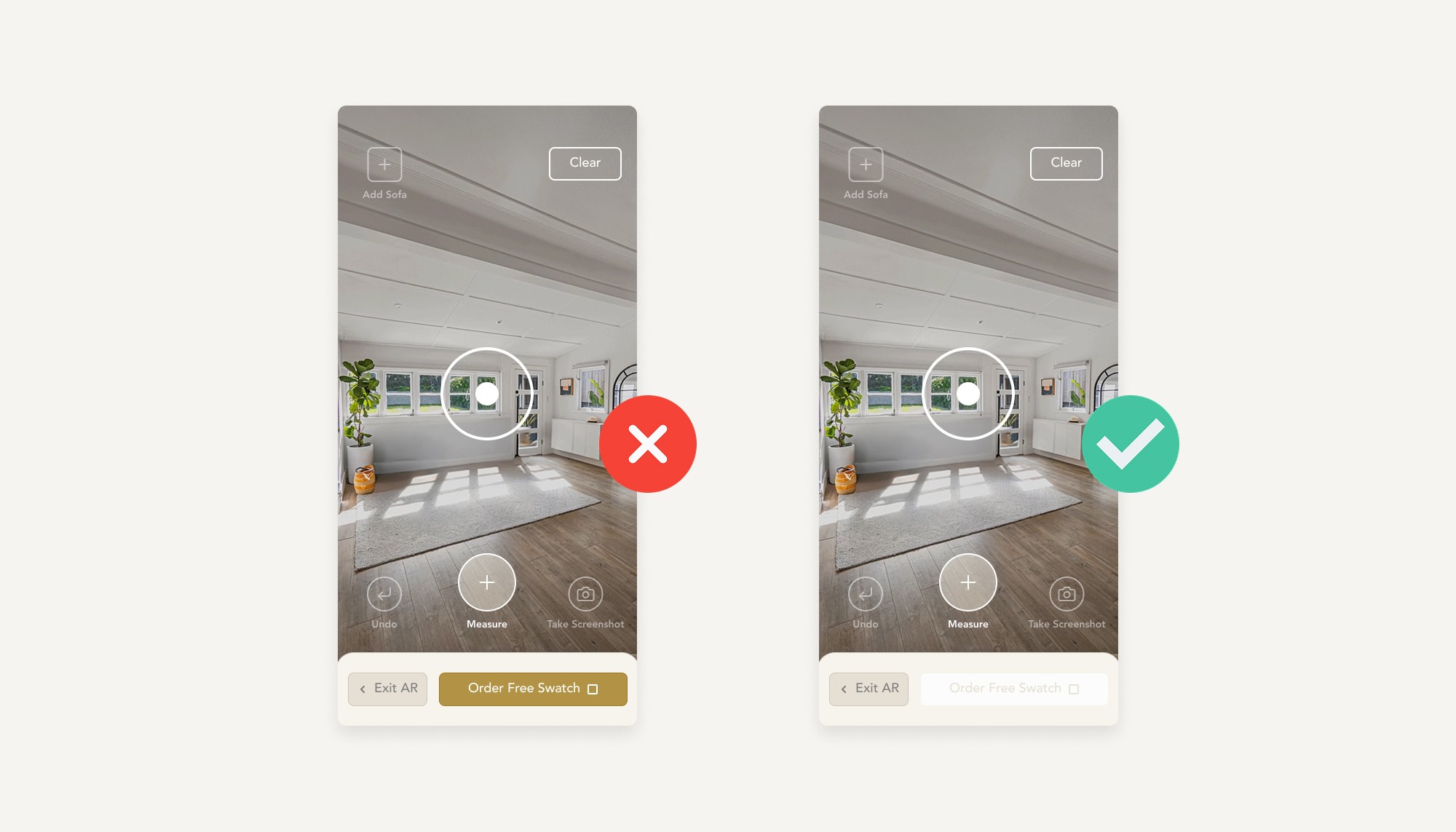
Finding
Swatch button competing with the measurement step
The Swatch button was styled in the primary pattern, so users clicked it before completing the measurement steps, skipping the exact stage meant to validate fit.
Decision
Demoted the swatch button to protect the fit check
I demoted the button visually to keep measurement the priority, while still keeping purchase accessible.